Skip to content

Luxury real estate website design examples are useful when they show how a premium property business earns attention, builds confidence, and turns interest into a conversation. A dramatic photograph is only the beginning. Buyers still need to explore homes, compare neighborhoods, understand the agent’s expertise, and request a viewing without friction.
This guide examines nine real brokerage and agent websites, from established global brands to focused local specialists. For each, you’ll discover the distinctive design choice, the business problem it addresses, and an idea worth adapting. You’ll also find a practical planning framework covering property search, editorial content, mobile speed, accessibility, SEO, and lead capture.
Quick answer: The best luxury real estate website design examples combine authentic property photography, consistent brand identity, useful property discovery, credible local expertise, and discreet ways to contact an agent. The right balance depends on whether the site represents an individual advisor, a boutique brokerage, or a multi-market real estate company.
9 Luxury Real Estate Website Design Examples and What They Teach
We selected these websites for their different approaches to luxury positioning, not because a visual preference proves that one converts better. Navigation, page content, and publicly visible features informed the analysis. We did not access their analytics, test lead conversion rates, or audit every mobile template. Treat the observations as design lessons rather than a performance ranking.
1. Sotheby’s International Realty: Sell the Lifestyle and the Destination
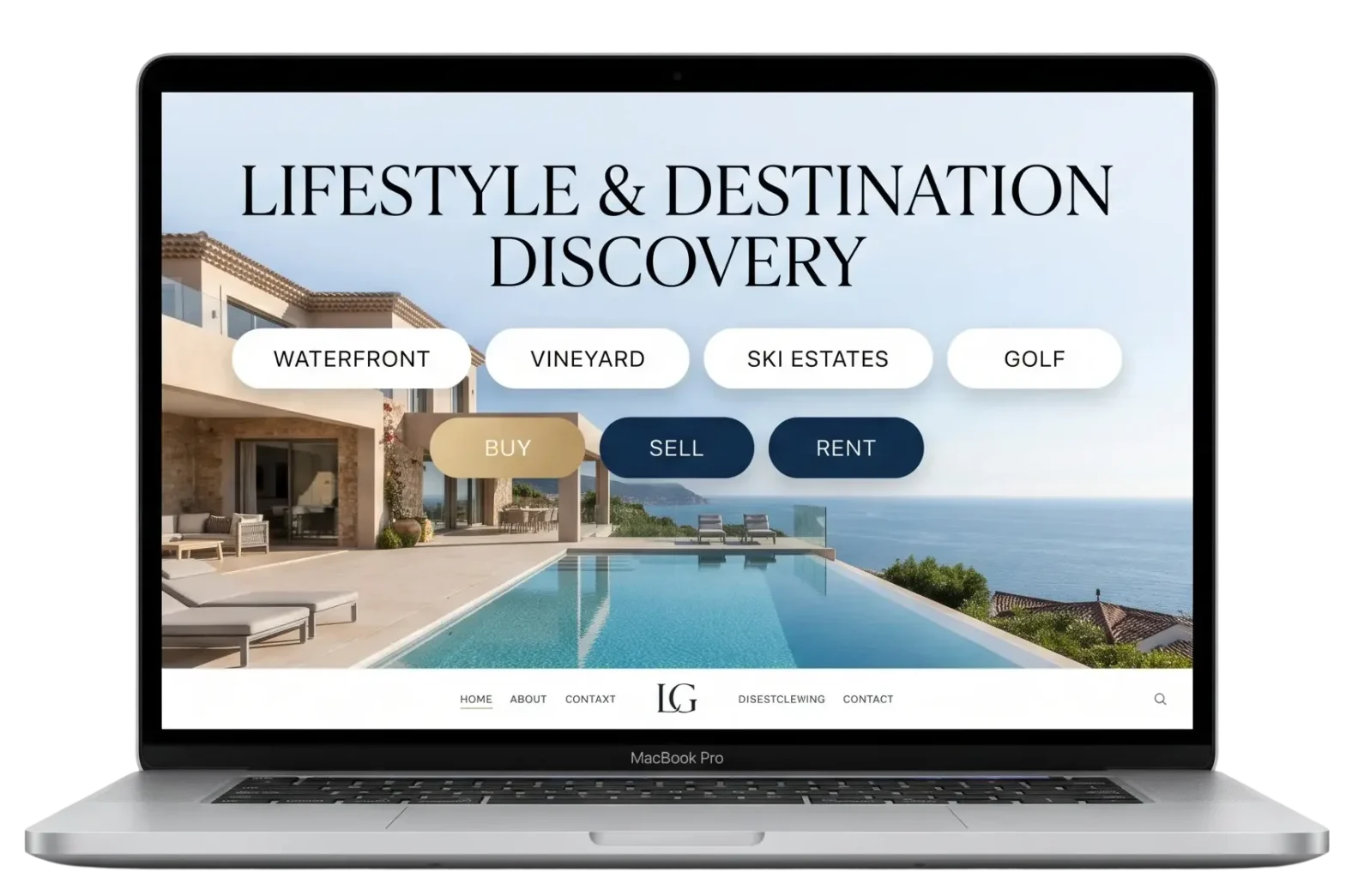
Among luxury real estate website design examples, Sotheby’s International Realty makes global discovery central to its experience. Visitors can browse homes by popular city, international destination, or lifestyle, including waterfront, ski, golf, and historic properties. Those pathways recognize something essential about affluent buyers: they may know the life they want before knowing the exact address.
Design lesson: Build entry points around buyer motivations, not just a generic search field. For a coastal brokerage, that might mean waterfront estates, dock access, and private beach properties.
What to adapt: Curated lifestyle collections with genuinely useful filters and dedicated destination pages.
What to avoid: Creating dozens of thin location pages without local knowledge, distinct copy, or enough property inventory.
2. Christie’s International Real Estate: Use Editorial Content to Build Authority
Christie’s International Real Estate offers luxury real estate website design examples that connect homes to art, design, collecting, and an international perspective. Its site features prestigious property listings alongside editorial material and market commentary. Instead of treating every page as a sales pitch, it provides reasons for a visitor to explore the brand between property searches.
Design lesson: Luxury real estate website editorial design is strongest when beautiful presentation adds real understanding. A well-written architectural story should clarify what makes the home unusual, not simply describe it as exceptional.
What to adapt: An editorial module beside curated estates, local architecture guides, and genuinely informative market articles.
What to avoid: Generic lifestyle articles with no connection to the neighborhoods or properties your team represents.

3. The Agency: Make Multiple Markets Easy to Navigate
In luxury real estate website design examples built for several markets, The Agency opens clear routes for buying, selling, and renting, then supports discovery through location search and regional exploration. Visitors can move from the broad brokerage identity to a particular area without navigating a maze of property cards. Featured regions help the site serve different audiences without treating them as one undifferentiated group.
Design lesson: Let the visitor choose a task first, then narrow by location. Buyers, sellers, and renters should not have to compete for the same single button.
What to adapt: Distinct intent-based navigation and region hubs with clear paths to agents and listings.
What to avoid: Duplicate city pages that differ only in the location name.
4. SERHANT: Build a Memorable Agent and Media Brand
SERHANT. combines a recognizable brokerage identity with property discovery and media. Its website separates buying, renting, selling, new development, and agent discovery. Market knowledge, guides, and studio-related content reinforce the company’s broader public presence.
Design lesson: A recognizable voice should connect to useful navigation. Personality creates interest; searchable listings and specific next steps let visitors act on it.
What to adapt: Consistent agent imagery, practical video explainers, and a content hub tied to the markets you actually serve.
What to avoid: Autoplay media that delays property search or makes mobile navigation difficult.
5. Jade Mills Estates: Let Personal Reputation Lead
Of the luxury real estate website design examples for individual advisors, Jade Mills Estates stands out with a clear emphasis on the person behind the service. Its site offers exclusive listings, sold homes, communities such as Beverly Hills and Malibu, and direct contact options. The agent’s positioning sits alongside evidence of market specialization, rather than disappearing beneath a general property directory.
Design lesson: Make the agent identifiable early. Add a relevant biography, credentials that can be verified, and market-specific expertise before filling the homepage with generic claims.
What to adapt: A concise introduction, proof of relevant work, selective listings, and neighborhood pages that demonstrate local understanding.
What to avoid: Unverified sales totals, rankings, or testimonials displayed without context.
6. Carolwood Estates: Treat Privacy as Part of the Experience
Among discretion-led luxury real estate website design examples, Carolwood Estates distinguishes exclusive listings, sold properties, and off-market opportunities. That organization matches the needs of clients who may prefer selective exposure or a more private conversation. The site also presents its Beverly Hills positioning and portfolio prominently without requiring every visitor to take the same path.
Design lesson: Discretion is a practical feature, not merely an elegant color palette. Private inquiry flows, careful consent wording, and restrained forms can support the relationship.
What to adapt: Separate pathways for public and private inventory, clear agent contact details, and consent-aware forms.
What to avoid: Promising access to off-market homes you are not authorized to advertise or disclose.
7. Douglas Elliman: Combine Listings With Research
Douglas Elliman supports property search alongside new developments, market reports, research, and buying and selling guides. This gives visitors a reason to return when they are not ready to schedule a viewing. It also allows local specialists to discuss market conditions in more useful terms than a generic ‘best agent’ claim.
Design lesson: Position a brokerage as a source of usable local intelligence. Reports should carry dates, geographic scope, and clear definitions for the figures shown.
What to adapt: Updated market guides, development pages, and links from neighborhood content to relevant properties and agents.
What to avoid: Stale reports that appear current because the page automatically displays today’s date.
8. Ginger Martin + Co: Make the Neighborhood Part of the Brand
Ginger Martin + Co centers its positioning on Napa Valley and Sonoma Valley, with properties, notable sales, local communities, and lifestyle material. The site communicates a specific place and type of inventory rather than relying on a universal luxury aesthetic. That focus is particularly valuable for vineyard estates, land, and lifestyle-driven purchases.
Design lesson: Build the visual language from your actual geography. Napa vineyards, Aspen mountain access, and Miami waterfront living call for different content and filters.
What to adapt: Local landscape imagery, precise area guides, and property details relevant to the destination.
What to avoid: Borrowing imagery from unrelated locations simply because it looks luxurious.
9. Louise Phillips Forbes Team: Sequence Brand, Proof, and Search
The Louise Phillips Forbes Team pairs a personal team identity with listings, past closings, an experience-led introduction, and a dedicated property search. Visitors can move from reputation to relevant inventory without losing the sense that a real team stands behind the website.
Design lesson: Present a clear introduction, one or two supported proof points, and then the relevant property or consultation route. Let the website establish confidence progressively.
What to adapt: Team biographies, relevant past sales with appropriate permissions, and concise search tools.
What to avoid: Animated statistics that show incorrect temporary values before scripts load.
Quick Comparison of the Nine Design Approaches
| Website | Strongest design idea | Most useful for |
|---|---|---|
| Sotheby’s International Realty | Lifestyle and destination discovery | International or multi-market brokerages |
| Christie’s International Real Estate | Editorial property storytelling | Architecture-led and heritage properties |
| The Agency | Clear buyer, seller, and rental journeys | Growing brokerages across regions |
| SERHANT. | Distinct personality plus media | Content-led teams |
| Jade Mills Estates | Individual advisor authority | Independent luxury agents |
| Carolwood Estates | Public and private inventory pathways | Discretion-focused brokerages |
| Douglas Elliman | Market research alongside listings | Research-led luxury firms |
| Ginger Martin + Co | Deep destination identity | Resort and vineyard markets |
| Louise Phillips Forbes Team | Agent credibility followed by search | Established real estate teams |
Luxury Real Estate Website Design Best Practices That Matter
Across these premium real estate website design examples, the strongest recurring idea is relevance. Luxury does not require gold accents, dramatic transitions, or a black background. It requires a visual identity and information structure that fit the clientele, homes, and market.
Start with authentic property imagery. Commission or license photographs that show real properties you represent. Use a carefully chosen hero image and descriptive captions. Supplement wide architectural views with details that help buyers understand materials, floor plans, outdoor areas, and the surrounding environment.
Respect typography and contrast. Editorial serif headings can establish character, while clear body type keeps practical information readable. Test text against both bright and dark photography. A sophisticated homepage that forces visitors to squint does not provide a premium experience.
Make every call to action relevant. A property page may offer ‘Arrange a Private Viewing.’ A seller page might offer ‘Discuss Your Property.’ A neighborhood page may lead to ‘Explore Available Homes.’ A consultation should feel like a natural next step, not an interruption.
Keep the mobile experience complete. Menus, photo galleries, filters, directions, and inquiry forms must work on small screens. Consider reduced-motion preferences and make video optional when possible. Attractive desktop mockups are not enough.
The Essential Pages and Features for a Luxury Brokerage Website

Luxury real estate website design inspiration becomes useful only when translated into an actual site structure. Most agent and brokerage websites need a homepage, listing search or curated inventory, property detail pages, about and team profiles, market and neighborhood guides, seller information, and contact options.
A thoughtful property page includes the address or permitted location, verified price and status, meaningful property specifications, an accessible image gallery, accurate descriptive copy, and a prominent viewing inquiry. Tours and floor plans are useful when available and authorized.
A neighborhood page should answer specific buyer questions about the housing stock, architecture, lifestyle, commute considerations, and types of homes on offer. Link it to relevant listings and local agents. Avoid unsupported claims about investment returns or neighborhood suitability.
A seller page should explain the representation process: positioning, professional photography, distribution, showing arrangements, communication, and reporting. It should not promise an above-market sale price or a guaranteed timeline.
A contact page needs a clear next step, privacy information, accessible form labels, and alternative contact details. For international buyers, make time zones and remote viewing options easy to understand.
IDX, MLS, SEO, and Property Search for Luxury Buyers
When reviewing luxury real estate website design examples, check how listings reach the page. IDX stands for Internet Data Exchange, the policy framework that allows authorized MLS participants to display qualifying listing information on public websites. MLS means Multiple Listing Service, a cooperative listing database governed by its participating organization. IDX permissions, feed access, and display requirements vary by market.
For a buyer-led brokerage, IDX can make a searchable inventory practical. It may enable filters by location, price, bedrooms, amenities, and property type. In some specialist businesses, curated exclusive listings and an inquiry-first experience may matter more. Off-market listings should never be exposed without permission.
Do not assume an IDX plugin automatically creates valuable SEO pages. Search engines decide which pages to index. Duplicate listing descriptions, expired property pages, thin neighborhood content, and blocked JavaScript can limit discovery. The more durable opportunity is to pair a usable search experience with original market information and clear internal links.
For teams planning this architecture, Codflux connects real estate marketing with custom web design and development and search engine optimization. These are related, but they solve different problems.
Custom Design or Real Estate Website Design Templates?
Luxury real estate website design examples may inspire a template, but cannot replace original market research. Real estate website design templates can be sensible for a new agent with a limited budget and straightforward needs. Look for flexible typography, responsive galleries, accessible navigation, and integration with the tools you actually use. Ask who owns the domain, content, images, and exported leads.
Custom design becomes more appropriate when a brokerage has distinctive brand standards, multiple regions, complex property filters, or a specialized seller workflow. The best luxury real estate website design is not necessarily the one with the largest build budget; it is the one that makes the business easier to understand and contact.
If an existing site has sound content but weak navigation, a focused website redesign may be more efficient than rebuilding everything. The right scope depends on analytics, templates, integrations, and technical condition, not on appearance alone.
How Luxury Real Estate Websites Can Support SEO, AEO, and GEO
For luxury real estate website design examples to support discovery, search engine optimization must help relevant pages become findable. Answer engine optimization makes useful answers clear. Generative engine optimization focuses on content that can be understood, attributed, and considered by AI-powered search experiences. None of these disciplines guarantees a specific ranking or citation.
A high-end real estate website design can support all three when its content includes real entities, defined market boundaries, and reliable information. Identify the brokerage, agents, locations, property categories, and services consistently. Use direct answers within neighborhood and selling guides, then add evidence and context.
Publish original descriptions and practical comparisons. Maintain a genuine author bio, descriptive image text, accurate publication dates, and a clear revision process. Relevant content marketing supports these pages without duplicating your commercial service landing pages.
Industry research also explains why the human relationship belongs in the design. The National Association of REALTORS® Profile of Home Buyers and Sellers examines how buyers and sellers work with agents. Use current findings carefully and do not assume national patterns precisely describe every luxury submarket.
A Practical Checklist Before You Build or Redesign
Use this checklist to turn luxury real estate website design examples into measurable decisions:
- Define the visitor: Distinguish luxury buyers, potential sellers, relocators, investors, and referral partners.
- Choose your positioning: Identify a real geographic or property specialty instead of claiming to serve everyone.
- Audit the current journey: Test how many steps visitors need to find a listing or request a conversation.
- Select genuine proof: Use authorized recent sales, agent credentials, publications, or documented case studies.
- Plan search and content: Decide whether IDX, curated listings, neighborhood pages, or all three best fit your operation.
- Build mobile-first: Check image loading, tap targets, menus, forms, contrast, and page responsiveness.
- Measure meaningful outcomes: Track qualified inquiries, viewing requests, seller consultations, and form completion rather than visits alone.
A concise Codflux project portfolio review can help you evaluate related design work; assess each example by its audience and deliverables rather than assuming unrelated client results transfer to your market.
Frequently Asked Questions About Luxury Real Estate Website Design
What makes a luxury real estate website different from a standard agent site?
The strongest real estate agent website examples often emphasize editorial-quality property imagery, discreet communication, strong personal or brokerage positioning, and destination expertise. Standard sites may prioritize broad listing search. Neither approach is automatically better; the right structure depends on clients and inventory.
Do luxury real estate websites need an IDX search tool?
Not always. IDX can be useful for firms serving buyers who expect to explore MLS listings. A private-client specialist focused on exclusive properties may prefer curated inventory, with a clear process for requesting additional information. MLS rules and permissions still apply.
Which design style works best for a high-end real estate agent?
Choose a style that matches your properties and brand. A minimalist editorial design may suit architectural homes, while a place-led visual approach can serve resort estates. Readable text, easy navigation, authentic photography, and confident contact routes matter more than trends.
Are luxury real estate website design examples worth copying directly?
Use them as references for principles, not as templates to duplicate. Copying another brokerage’s imagery, copy, brand marks, or distinctive visual assets creates legal and credibility risks. Translate useful choices into original work informed by your clients and geography.
Can a template-based site rank in Google and appear in AI search?
Yes, if it is technically accessible and provides useful, original, well-organized content. Custom code alone does not create authority. Search visibility depends on many factors, including competition, relevance, crawlability, site quality, and evidence behind the page.
What should a luxury property website include for sellers?
Show the agent’s experience, market coverage, marketing process, property presentation standards, communication approach, and a discreet consultation path. Explain how pricing advice and marketing decisions work. Avoid guarantees about sale price, speed, or the number of inquiries a listing will generate.
How can a luxury real estate website generate better inquiries?
Make the next step specific to the page: private tour requests from property listings, valuation conversations from seller pages, and local expert consultations from neighborhood guides. Keep forms concise, respect consent preferences, and follow up through a documented process. Evaluate inquiry quality, not just submission volume.
Final Thoughts on Luxury Website Design
The most useful luxury real estate website design examples reveal a shared discipline: every visual choice should help visitors understand a property, a place, or the professional representing it. Sotheby’s shows lifestyle discovery; Christie’s demonstrates editorial context; smaller specialist brands show the power of local identity and personal trust.
Choose the ideas that fit your clients, build pages around real questions, and measure what happens after visitors arrive. To discuss a site tailored to your brokerage, contact Codflux.